
Home / News & advice / Hair health
How does Rigenera treatment for hair loss work?
Sampling, preparation and injections: understand autologous micrografts and questions to ask before a session.
The essential benchmarks
What to remember
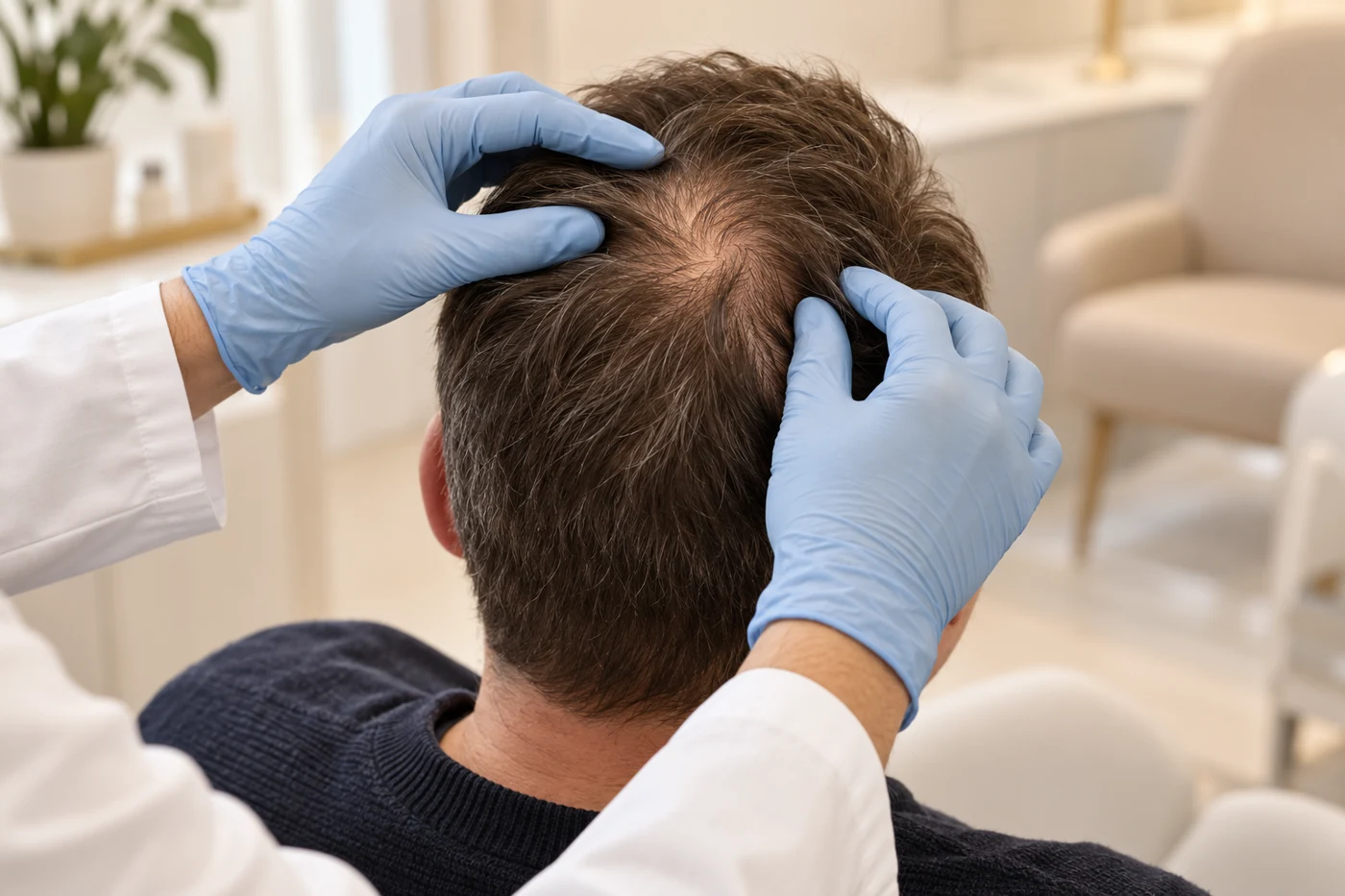
Rigenera is based on the mechanical preparation of small tissue samples from the patient, then reinjecting them into the scalp. This procedure is distinguished from a hair transplant and begins with a diagnosis of the hair loss.
Why start by examining the scalp?
A diffuse hair loss after a disease, an androgenetic alopecia and a plaque suddenly appeared do not require the same management. The doctor looks for seniority, the distribution of loss and the associated signs: itching, redness or pain.
The history, treatment and possible analyses already performed help guide the assessment. Choosing a technique before identifying the cause exposes to dealing with the wrong problem.
What is the technique?
The method uses small skin samples under local anaesthesia. The fabric is then mechanically prepared with a dedicated device to obtain a micrograft suspension, reinjected into the areas defined during examination.
It is a procedure with sampling and injections. The term "autologous" means that the fabric comes from the person himself; it does not mean that the procedure is without risk.
What's the difference with a hair transplant?
A scalp transplant moves follicular units to a degarned area. The preparation of micrografts does not have the same objective: it is studied for its action in areas where follicles are still present.
Therefore, it should not be presented as a way to systematically recreate a hair on a smooth and old area. The degree of thinning and the likely evolution of alopecia are part of the choice.
What do we know about the results?
Clinical studies have explored this approach in androgenetic alopecia. Their existence does not make it possible to predict a person's response, nor to set an identical maintenance schedule for all.
Before a session, ask what data support the proposed indication, how density will be assessed and when a photographic balance will be made. Comparable photos, with the same light and hairstyle, are more useful than an impression collected just after treatment.
Practical questions to ask
Specify the total duration of the appointment, anesthesia, number of samples, possible local suites and washing instructions. Sampling and injections may result in sensitivity, small bleeding or local marks; infection is also possible.
The estimate and protocol must specify what is provided for in your situation. Consult the guide to hair services and Article on the causes of hair loss in women to prepare your questions.
A question about your situation? The practice welcomes you to 4 Passage Lonjon, Place de la Comédie in Montpellier.
Contact the practiceMedical sources and information
Updated on 20 October 2026. The information presented makes it possible to prepare the consultation; the choices of care are specified during the appointment.